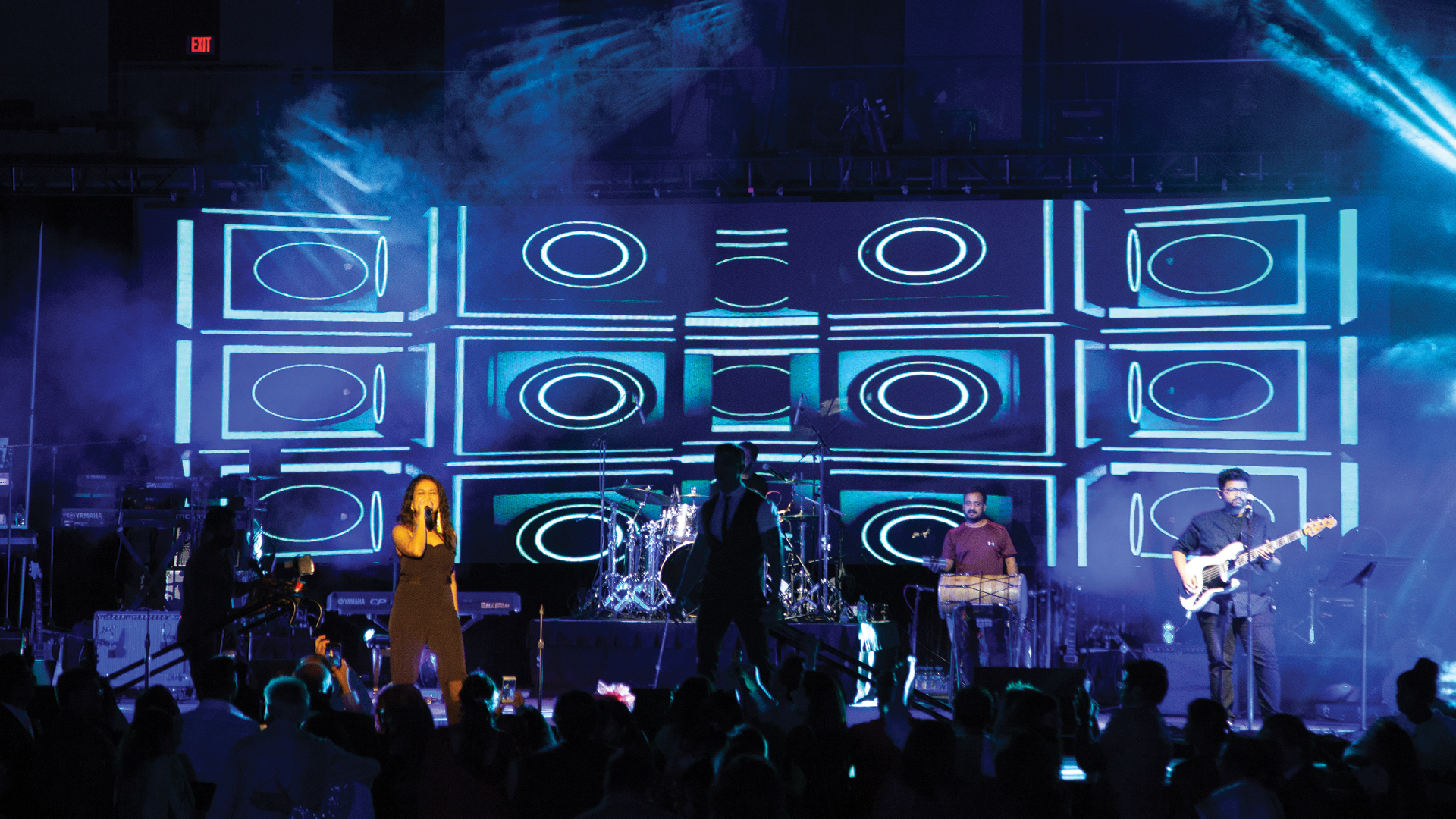
There is a physical conversation happening below 80 Hz at every major festival site — one felt in the chest, the sternum, the bones. It is engineered, not accidental. The subwoofer ground array is the product of decades of acoustic science, rental company expertise, and hard-won stage knowledge. Deployed at over 70 large-scale festivals annually across North America and Europe alone, these configurations represent one of the most consequential — and least visually obvious — components of modern live sound production.
The Physics Behind the Ground Plane Effect
Traditional sub deployment stacks large-format subwoofer cabinets vertically on stage wings. This approach, still common at smaller events, creates predictable lobing patterns — zones of reinforcement and cancellation caused by the physical distance between drivers. The ground array approach exploits a fundamentally different acoustic principle: boundary reinforcement. When a subwoofer fires horizontally from ground level, it couples with the earth beneath it, gaining approximately 6 dB of free acoustic reinforcement without any additional amplification. This is pure physics, exploited deliberately.
The acoustic foundations for this approach were well understood by researchers and touring sound engineers through the late 1980s and 1990s, but deployment logistics limited practical application until modular cardioid sub configurations emerged as reliable rental-scale solutions in the mid-2000s. Engineers working with systems from d&b audiotechnik, L-Acoustics, and Meyer Sound developed cardioid subwoofer arrays that dramatically reduced rear-facing bass energy — a critical development for festivals where stage monitors, FOH positions, and neighbouring stages create competing energy fields.
Cardioid Configuration: The Dominant Festival Standard
The cardioid ground array has become the dominant bass deployment strategy at festivals with main stages above 30,000 capacity. The principle involves inverting one or more subwoofer cabinets within an array so their rear-radiating acoustic energy partially cancels the rear output of forward-facing cabinets. The d&b SL-Series and L-Acoustics KS28 are among the most widely deployed cabinet types in this configuration, with their physical dimensions and port geometry engineered to behave predictably in cardioid arrangements. When properly configured using ArrayCalc (d&b’s free simulation software) or L-Acoustics Soundvision, cardioid arrays can achieve 15–20 dB of rear rejection — translating to dramatically improved monitor mixes and reduced stage bleed.
Festival deployments at events like Glastonbury, Coachella, and Tomorrowland routinely deploy 48–96 subwoofer cabinets in ground array configurations for a single main stage. The L-Acoustics K1-SB and d&b J-SUB see particularly heavy rotation in rental inventories targeting this application, prized for their coupling efficiency and predictable integration with line array systems flown above.
The Role of Prediction Software in Festival Planning
No serious rental company deploys a festival ground array based on intuition. The pre-production workflow involves hours of acoustic modelling using platforms like EASE, Renkus-Heinz’s RHAON, or the manufacturer-native tools already mentioned. Festival site plans — often drawn from AutoCAD or Vectorworks files — are imported into simulation environments where engineers model audience coverage contours, identify null zones, and optimise cabinet quantity and placement before a single truck arrives on site.
The subwoofer delay strategy is another dimension of this pre-production science. Large festival ground planes require delay-time compensation between sub arrays and flown line arrays — typically managed through Lake LM 44 or Dolby Lake Processor units, or within modern digital console processing. Getting the time alignment wrong by even 2–3 milliseconds creates bass frequency comb filtering audible to trained ears and felt as an unclear, muddy low-end character by general audiences.
Deployment Logistics: The Invisible Infrastructure
A festival ground array for a 50,000-capacity event involves 4–8 articulated lorries dedicated solely to subwoofer transport. The load-bearing capacity of stage front ground surfaces becomes a practical production parameter — temporary metal ground protection plates are standard equipment on any festival advance crew’s shopping list. Power distribution for 64 subwoofers running Crown iTech HD or Lab.gruppen PLM Series amplifiers demands careful electrical load planning from the venue’s primary feed, often requiring temporary transformer installations and custom Socapex distribution harnesses.
Perhaps no element of festival bass infrastructure is more underappreciated than cable management at ground level. Thousands of metres of Neutrik NL4 and NL8 speakON cables, touring-grade RJ45 AES70/OCA network trunks, and power feeder cables must be routed safely across surfaces traversed by crew, equipment, and in some configurations, audience members. Touring-grade cable ramp systems from manufacturers like Adam Hall and Eurolite are as critical to festival safety infrastructure as any acoustic consideration.
End-Fire Arrays: The Premium Alternative
While cardioid configurations dominate, end-fire sub arrays occupy a premium niche in festival production. An end-fire arrangement positions multiple subwoofer columns in a line perpendicular to the audience, separated by calculated distances with progressive delay applied to rear rows. The combined acoustic effect creates a highly directional forward lobe of bass energy with significantly improved front-to-back ratio compared to even well-engineered cardioid arrays.
The tradeoff is space. An end-fire array for 50+ Hz coverage with meaningful directional control may require 6–8 metres of stage depth — space that competes directly with stage performance area, power infrastructure, and monitor positions. This is why end-fire configurations appear most frequently at dedicated electronic music festival stages where DJ riser and monitor simplicity reduces the spatial competition, allowing bass reproduction to be prioritised architecturally.
Hybrid Festival Strategies: Stacked, Flown, and Grounded Together
The most sophisticated festival bass deployments in 2024 combine strategies. A hybrid sub system might employ a primary ground array for the front 50 metres of audience depth, supplemented by flown infra-sub cabinets addressing the upper tiers of large venue structures, and sub delay stacks at 60–100 metre audience positions ensuring uniform bass SPL across the full listening plane. This architecture — requiring meticulous signal processing, real-time measurement with tools like Rational Acoustics Smaart and Meyer Sound SIM3, and experienced system technicians — represents the current state of the art in outdoor festival acoustics.
The 70+ festivals deploying these systems annually are not simply providing louder bass. They are delivering a precision acoustic architecture that hundreds of thousands of people experience through their entire bodies — an engineering achievement that deserves recognition alongside every other element of large-scale live production.
