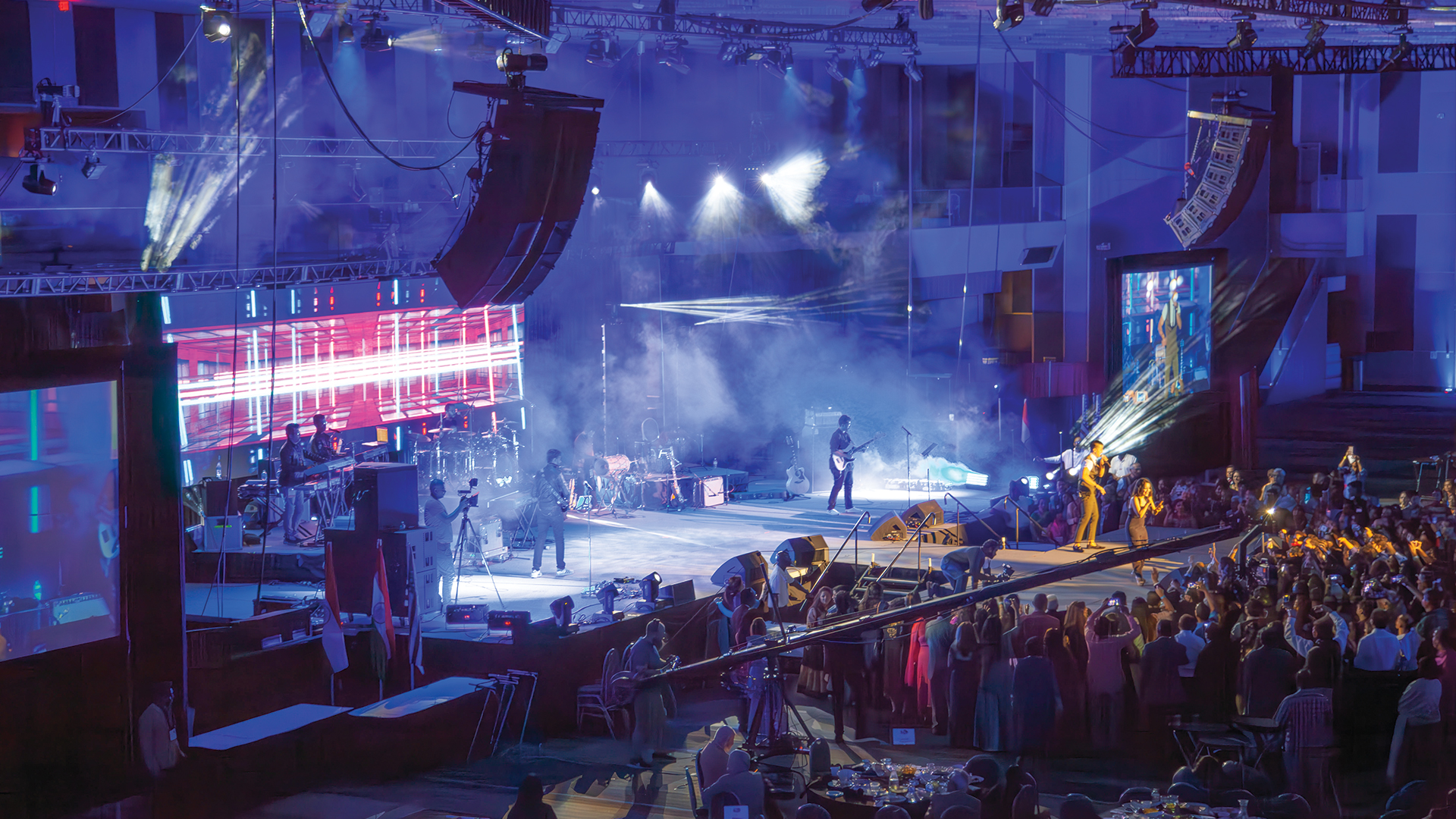
The pursuit of uniform bass across a festival ground is the acoustic equivalent of a precision engineering challenge. The audience at a 40,000-person festival spans a listening plane 100 metres wide and 80 metres deep — a surface covering roughly 8,000 square metres. Delivering bass frequencies with consistent Sound Pressure Level (SPL)) and spectral balance across every position in that plane, simultaneously, while managing the boundary conditions at its edges and the interference effects between multiple source positions, is the central technical problem of outdoor festival bass production). The solutions employed today represent the current state of accumulated acoustic science, engineering ingenuity, and hard-field experience.
Defining Uniformity: The ±4 dB Standard
The professional standard for outdoor bass SPL uniformity) targets ±4 dB variation across the primary audience area in the frequency range 40–120 Hz. This standard, adopted by major festival production companies and recommended by acoustic consultancies including Arup Acoustics) and AECOM’s acoustics group), represents a pragmatic balance between achievability and audience experience quality. Tighter targets — ±2–3 dB — are achievable in smaller, better-controlled environments but require infrastructure investment that scales non-linearly with audience area.
At frequencies below 60 Hz — the range that produces the physical bass sensation most associated with electronic music festivals) — achieving even ±6 dB uniformity across an 8,000 m² audience plane represents a significant engineering achievement. Wavelengths of 5–8 metres in this range produce interference patterns whose spatial periodicity is comparable to crowd density, meaning that individuals standing 3–5 metres apart may experience 6–10 dB SPL differences at specific low-frequency bands. This is the technical reality of festival bass) — partially manageable through clever array design, but never fully eliminable given the physics of low-frequency propagation.
Array Design Strategies for Uniform Coverage
Achieving the best possible uniformity begins with array design decisions made months before the event. The primary variable is the spatial distribution of subwoofer source positions). A single centrally-located ground array maximises coherent output but creates significant coverage variation across the audience width — the near-centre audience receives substantially more LF energy than those at far-left and far-right positions. Distributed left-centre-right sub configurations) — three separate sub clusters positioned at stage left, stage centre, and stage right — distribute source positions more evenly relative to the audience plane, reducing the lateral SPL gradient at the expense of more complex control requirements and potentially higher mutual interference between array positions.
The extended cardioid configuration) has emerged as the dominant approach for achieving uniformity combined with directivity in festival main stages above 30,000 capacity. A well-designed extended cardioid ground array using 48+ d&b KSL) or L-Acoustics KS28 cabinets) can achieve approximately 18 dB of rear rejection while maintaining ±4–5 dB uniformity across the front 70 metres of audience depth — a result confirmed through measurement at festivals including Ultra Music Festival), Untold Festival), and EDC Las Vegas) where these configurations have been deployed and documented.
Real-Time Correction: Responding to the Crowd
A festival audience is a dynamic acoustic environment. As 40,000 people arrive over the course of a day, their bodies absorb sound energy — particularly in the 250 Hz–2 kHz range) — changing the acoustic absorption characteristics of the space measurably. But bass frequencies are less affected by audience absorption, and the dominant effect of audience arrival on low-frequency uniformity) is the change in ground plane coupling as the earth surface is covered by thousands of bodies. System engineers monitoring bass performance across the day use wireless measurement microphones) at fixed audience positions — typically at 20%, 50%, and 80% depth — to track these changes and apply real-time corrections through remote amplifier control software
Meyer Sound’s MAPP XT prediction software) and the newer MAPP 3D platform) have enabled a more sophisticated approach to real-time monitoring by allowing predicted coverage maps to be overlaid with measured data in real time, making deviations from target performance immediately visually identifiable. System engineers using this workflow can diagnose the source of coverage anomalies — whether a mechanical rigging shift has changed an array’s tilt angle, or an amplifier channel has entered thermal limiting, or atmospheric conditions have shifted the effective speed of sound — and implement corrections before the discrepancy becomes audience-audible.
Subwoofer Delay Lines: Extending Uniform Coverage to 100+ Metres
For festival audiences extending beyond 60–70 metres from the main stage, the subwoofer coverage) from ground arrays positioned at the stage degrades naturally due to air absorption and inverse-square law level reduction. The professional solution is delay subwoofer stacks) — additional ground arrays positioned 40–60 metres into the audience plane with delay-time correction applied to maintain Haas-window timing) relative to the main system. These delay stacks, typically smaller arrays of 8–12 L-Acoustics SB28) or d&b B22-Sub) cabinets, supplement the main system’s bass SPL at rear audience positions without creating competing bass sources that degrade time coherence.
Deploying delay sub stacks in a festival audience area requires careful logistics: robust physical protection from crowd pressure, clearly marked exclusion zones, crew access paths) for system checks between acts, and structural ground plates that prevent cabinets sinking into soft ground under their combined weight during multi-day events. The flight case logistics) of getting delay stacks positioned correctly within tight show-day timelines — when the audience is already on site for support acts — demands precise pre-planning and a dedicated delay stack crew team that operates independently from the main stage audio build.
The Standard-Setting Events: Where Best Practice is Proven
The outdoor festivals that have most consistently advanced the state of festival bass uniformity) are not necessarily the largest — they are those with the most technically demanding audiences and the most invested audio production values. Dekmantel) in Amsterdam, Printworks London), and the audio design team behind Awakenings Festival) have collectively contributed to a body of field knowledge about bass uniformity achievement in outdoor environments that has influenced production practice globally. Their willingness to invest in measurement-intensive system engineering), document results, and share methodology through industry channels like Rational Acoustics’ Smaart forums) and Live Sound International) has elevated the entire discipline.
For every AV professional involved in outdoor festival production — from the rental company system tech checking cable continuity at 6 AM to the mix engineer riding faders through a headline set — the goal of uniform bass coverage) across every square metre of festival ground is the acoustic ambition that unifies the entire production effort. Its achievement, night after night at festivals worldwide, is one of the quiet triumphs of the live sound profession.
