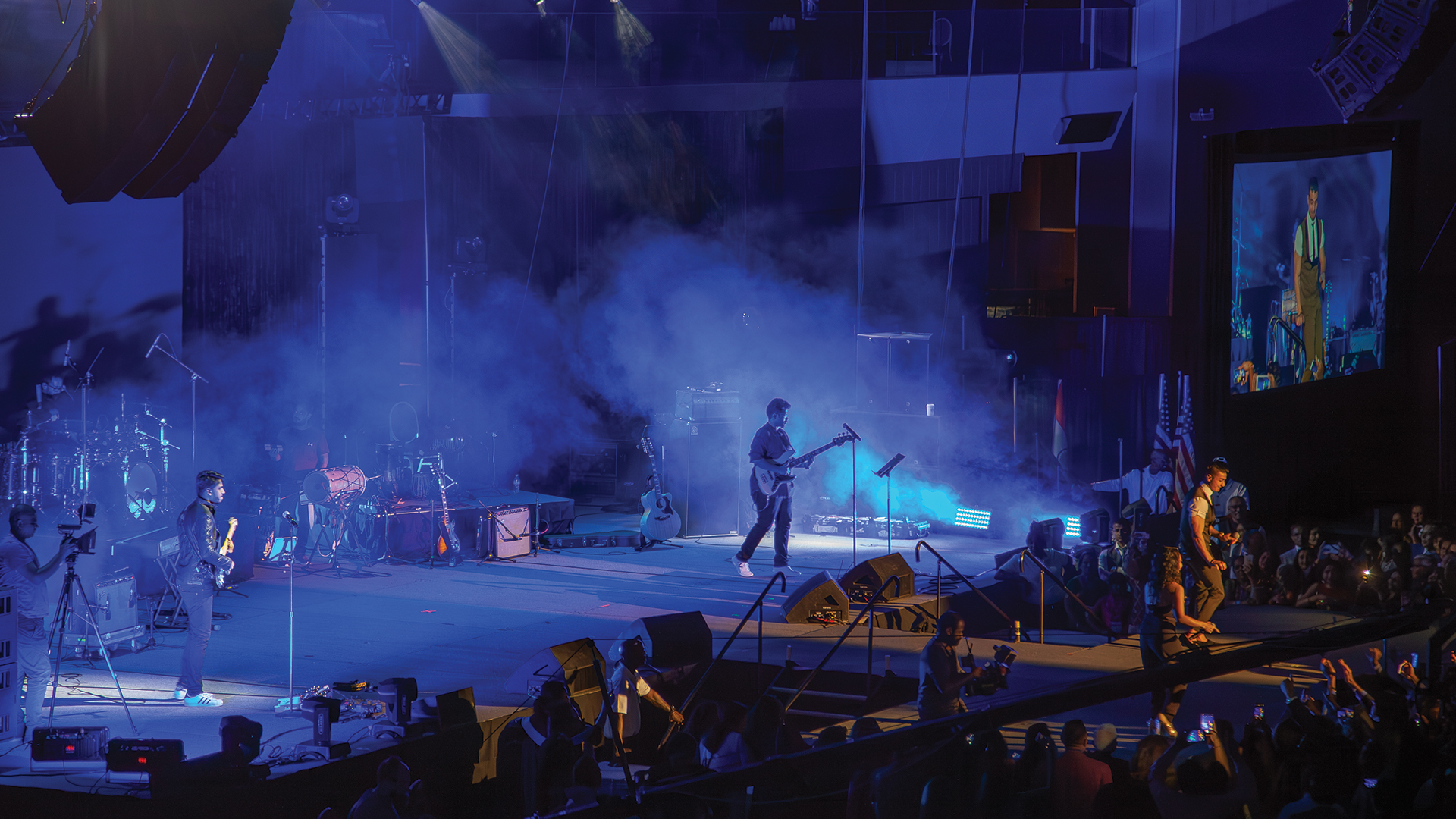
Consistent bass coverage across a festival crowd of 30,000+ is one of the most technically demanding achievements in live sound — and one of the least appreciated by the audiences who benefit from it. At 150+ major festival events deploying subwoofer ground arrays annually, the infrastructure and expertise required to deliver uniform low-frequency coverage across audiences that span 50, 80, or 120 metres from stage to back represents decades of accumulated acoustic science translated into daily operational practice.
Coverage Uniformity: What ±3 dB Actually Means
Professional live sound standard practice targets ±3 dB SPL variation across the primary audience area in the frequency range relevant to intelligibility and musical impact. For bass frequencies — typically 40–120 Hz for festival main stages — achieving this uniformity is complicated by the omnidirectional radiation of subwoofer frequencies at practical audience distances, the ground reflection coupling that varies with surface type across a festival field, and the destructive interference patterns created by multiple subwoofer source positions. The ±3 dB standard is achievable with well-engineered arrays; the ±6–8 dB variations experienced at under-engineered events represent a significantly degraded listening experience for the 40% of the audience in the low-SPL zones.
The human perception of bass variation is somewhat forgiving in comparison to midrange: a 6 dB variation in bass SPL is noticeable but not immediately distressing, while the same variation in vocal frequencies creates obvious intelligibility problems. However, for the genre of electronic music and bass-heavy contemporary pop that dominates festival programming, the bass experience is central to the artistic intent of the performance — making uniform coverage a genuine artistic priority, not merely a technical benchmark.
Festival-Specific Challenges: Variable Ground Surfaces
Festival sites present ground surface variations that significantly affect subwoofer boundary coupling — the mechanism through which ground arrays gain additional output from reflection reinforcement. A main stage positioned on compacted soil or asphalt provides excellent coupling; the same array deployed on a wooden temporary stage platform, hollow metal deck, or soft turf grass exhibits measurably different coupling behaviour. System engineers working across 150+ festival configurations develop calibrated intuitions for these surface effects and adjust subwoofer level, delay time), and EQ settings) accordingly.
Seasonal ground moisture variation on multi-day festival sites adds another dimension. A festival that builds on dry ground on Thursday can face significantly different acoustic conditions by Sunday afternoon after rainfall, with saturated soil providing stronger ground plane reflection) and the atmospheric effects of increased humidity altering sound propagation velocity). Productions that schedule system checks) at the beginning of each festival day — rather than assuming conditions from the previous day persist — consistently deliver more uniform coverage across multi-day events.
Arrays by Numbers: The Scale of Festival Bass Infrastructure
The physical scale of festival ground array deployments) is instructive. A main stage serving 50,000 capacity might deploy 48–72 L-Acoustics KS28) or d&b KSL subwoofers) in a hybrid cardioid-ground array configuration. Each KS28 enclosure measures 1,050mm wide × 800mm deep × 575mm high and weighs 118 kg — meaning 48 units represents 5,664 kg of subwoofer hardware, typically requiring 2–3 dedicated transport vehicles) for festival hops.
The amplifier infrastructure to drive this array — typically Lab.gruppen PLM Series), Crown iTech HD), or d&b D80 Series amplifiers) in dedicated racks — adds another 800–1,200 kg and requires three-phase power distribution) with total current draws of 400–600 amps per rack row at peak. The Socapex distribution) harnesses, CEE 63A power feeds), and audio snake systems) completing the infrastructure represent a further 300–500 kg of hardware before a single note has been played.
Multi-Stage Coverage: The Cross-Stage Bleed Problem
At festivals with multiple stages operating simultaneously — the standard configuration for major European events like Download Festival), Isle of Wight Festival), and Hellfest) — cross-stage bass bleed) is a chronic challenge for both audio quality and festival operations. Subwoofer frequencies below 100 Hz propagate for hundreds of metres with minimal air attenuation, creating bass energy at adjacent stages that interferes with the sound systems there and creates a continuous background rumble across large festival sites.
Cardioid sub configurations) are the primary engineering tool for managing this bleed, reducing rear-stage radiation by 15–20 dB compared to conventional stacks. But even well-executed cardioid arrays cannot eliminate cross-stage interference at closely spaced multi-stage configurations. Festival audio directors — the production role responsible for inter-stage coordination — typically enforce scheduled operating windows) where certain stages observe low-volume or silent periods while adjacent stages perform, and establish bass frequency trims) that reduce LF output levels when two stages are simultaneously active at proximate times.
The Measurement Imperative: Daily SPL Verification
Delivering even coverage across 150+ festivals requires a discipline of measurement and verification) that prevents assumption from replacing confirmation. Rational Acoustics Smaart) running on a dedicated laptop with Earthworks M23 microphones) calibrated against a B&K 4231 reference microphone) is the standard field setup. Measurement positions are defined in advance during pre-production modelling and walked during soundcheck — the data compared against the Soundvision or ArrayCalc predictions to identify deviations requiring correction.
After 150+ festival deployments, patterns emerge. Certain venue types — large grass fields with gentle slopes, concrete bowl amphitheatres, wooden-decked temporary stages — behave consistently enough that experienced engineers can predict the correction requirements before measurement confirms them. This accumulated professional intuition), built on hundreds of measured data sets and thousands of hours of field experience, is the practical product of a career in festival audio. It is also the most difficult thing in the profession to teach and the most valuable thing an experienced engineer carries.
