Winter touring across North America presents production logistics challenges that fair-weather professionals never contemplate. The trucks carrying lighting rigs, audio systems, and video equipment must navigate interstate highways that transform overnight from routine routes into survival courses. When a major snowstorm intercepts a touring production, the resulting battle between show business determination and meteorological reality creates stories that become industry legend.
When the Blizzard Met the Buses
A headline arena tour traversing the northern United States in February faced what meteorologists termed a ‘historic winter event.’ The production—carrying 18 trucks of equipment and 6 artist tour buses—departed Denver bound for Minneapolis, a routine two-day jump under normal conditions. Weather forecasts suggested ‘possible winter weather’ without specifying the apocalyptic proportions that would actually materialise.
The production manager made the call to proceed based on available information. Twelve hours later, the convoy found itself stranded on Interstate 80 in Nebraska, surrounded by accumulating snow measured in feet rather than inches. The trucks carrying Upstaging lighting equipment and Clair Global audio systems formed an impromptu shelter line as visibility dropped to zero.
Communication became the first casualty. Cellular networks collapsed under demand as thousands of stranded motorists simultaneously attempted calls. The production’s satellite communication systems—carried for exactly such emergencies—became the only reliable link between the convoy, the Minneapolis venue, and the artist’s management team making difficult decisions about show cancellation.
The Historical Context of Tour Logistics
Modern touring infrastructure evolved from decidedly humble origins. In the 1950s and 1960s, acts transported equipment in station wagons and rented trucks, with performers themselves often serving as roadies. The British Invasion era began professionalising tour logistics, though equipment often arrived in questionable condition after transcontinental journeys.
The development of purpose-built tour trucks by companies like Upstaging, Theatrical Fabricators, and Rock-It Cargo transformed the industry. These vehicles feature climate control systems protecting sensitive electronics, air-ride suspension minimising transport damage, and GPS tracking enabling real-time convoy management. Yet even the most sophisticated logistics systems remain vulnerable to weather’s ultimate veto power.
The Equipment Recovery Operation
After 36 hours stranded on the frozen interstate, conditions improved sufficiently for movement. The production faced a brutal reality: the Minneapolis show was cancelled, but tickets were already sold for the Chicago date 48 hours later. The equipment must traverse 500 miles through still-challenging conditions, arriving with time for load-in, setup, and system commissioning.
The tour lighting director coordinated with local PRG and Christie Lites facilities to identify backup equipment that could be deployed if primary rigs arrived damaged or delayed. The audio crew chief developed contingency plans involving L-Acoustics inventory available from regional vendors. Every department prepared for scenarios ranging from partial equipment availability to complete system replacement.
Temperature management became critical. The trucks had maintained internal heating during the stranding, but fuel supplies were depleting. LED video wall panels from ROE Visual can suffer damage if subjected to extreme temperature swings. Moving light fixtures with precision optics require careful acclimation before operation. The crew monitored temperatures obsessively, knowing that cold-damaged equipment could doom the Chicago show even if the trucks arrived on schedule.
The Human Factor in Winter Touring
Beyond equipment concerns, the production managed 75 crew members scattered across buses and trucks. Catering supplies intended for the cancelled Minneapolis show provided sustenance during the stranding. The tour accountant coordinated emergency cash distribution via mobile payment apps when crews needed to purchase supplies from nearby truck stops.
Morale management fell to the production manager and department heads. Experienced crews understand weather disruptions as inevitable tour realities, but extended strandings test even veteran patience. Regular communication updates—possible only through the satellite systems—maintained crew confidence that leadership had situations under control.
The Chicago Setup Sprint
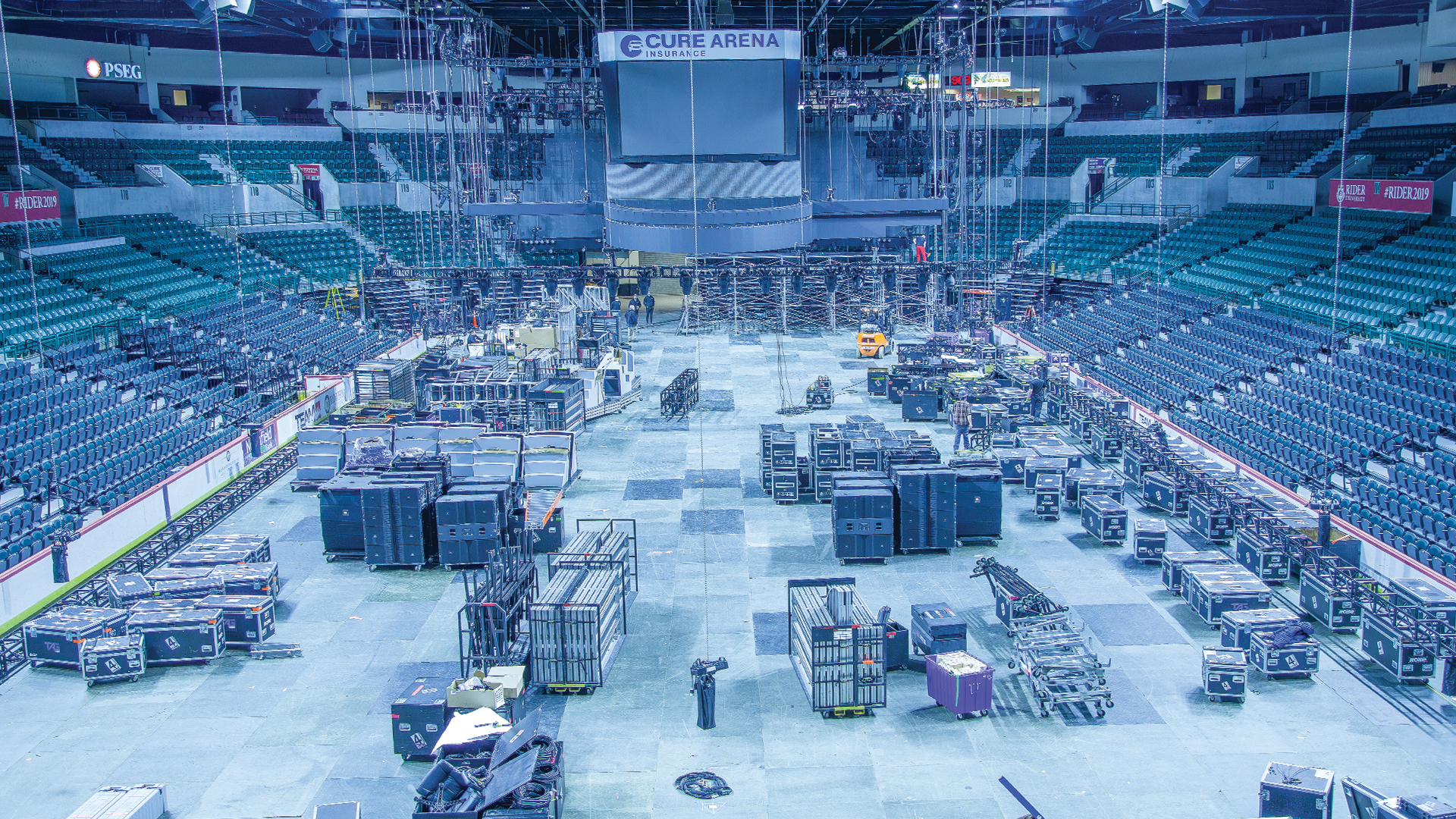
The convoy reached Chicago’s United Center at 4 AM for an 8 PM show—a compressed timeline that eliminated every normal buffer. The local crew had been pre-positioned, with IATSE stagehands arriving at 5 AM rather than the typical 8 AM call. Double crews were deployed for every department, enabling parallel operations that normal load-ins sequence linearly.
The rigging crew worked with extraordinary efficiency, hanging chain motors from Columbus McKinnon and CM Lodestar units while ground crews simultaneously assembled truss sections. The lighting programmer ran fixture diagnostics via the grandMA3 network while fixtures were still being positioned, identifying units affected by the cold exposure.
Equipment inspection revealed surprisingly minimal damage. Several Claypaky Mythos 2 fixtures required lamp replacement after cold stress affected their MSR lamp seals. Two subwoofer cabinets showed moisture intrusion requiring drying before deployment. The video walls performed flawlessly after proper acclimation—testament to the crews’ temperature management during the stranding.
Technical Adaptations for Weather-Affected Equipment
Cold exposure affects professional production equipment in predictable ways that experienced technicians prepare to address. LCD displays require gradual warming before operation to prevent crystal damage. Moving light motors benefit from reduced-speed operation during initial warm-up, allowing lubricants to reach optimal viscosity.
Audio equipment presents specific cold-weather challenges. Speaker drivers with rubber surrounds can stiffen, affecting frequency response until materials warm. Digital consoles should reach operating temperature before full processing loads are applied. The system engineer conducted SMAART measurements throughout the sound check, verifying that cold-affected components achieved specification as the arena warmed.
The Show Must Go On—And It Did
Doors opened at 7 PM for an 8 PM show—an hour later than advertised, negotiated with venue management to provide additional setup time. The audience, many of whom had also battled the storm’s aftermath to attend, responded with understanding born of shared adversity. Local media coverage of the production’s journey had created anticipation that transformed the performance into a triumph-over-elements narrative.
The artist acknowledged the crew’s efforts from the stage—a rare direct recognition that reduced several veteran technicians to emotional moments in dark backstage corners. The production team had overcome 60 hours of continuous crisis management to deliver a show that audiences rated among the tour’s best performances.
Post-mortem analysis led to immediate protocol changes. The tour invested in enhanced weather monitoring services providing route-specific forecasts. Emergency supply kits were expanded to include additional food, fuel, and medication reserves. Communication redundancy increased with the addition of more satellite communication devices distributed across the convoy.
Lessons for Winter Tour Planning
Winter touring requires contingency planning that accounts for complete schedule disruption. Routing should include potential refuge points—cities with arena facilities, equipment vendors, and accommodation capable of receiving entire productions should weather strand convoys.
Financial reserves must anticipate weather-related costs including cancelled shows, emergency accommodations, equipment repairs, and overtime for compressed load-ins. Insurance policies should explicitly cover weather cancellations, though claims processes often prove slower than the tour’s forward momentum requires.
The tour that survived the snowstorm became a touchstone story in AV production circles—evidence that preparation, professionalism, and determination can overcome even nature’s strongest objections. The crews who weathered those 60 hours carry that experience forward, sharing hard-won wisdom with younger technicians who will eventually face their own meteorological adversaries. In an industry built on making impossible things happen on schedule, survival stories remind everyone that some impossibilities merely require more effort than others.
