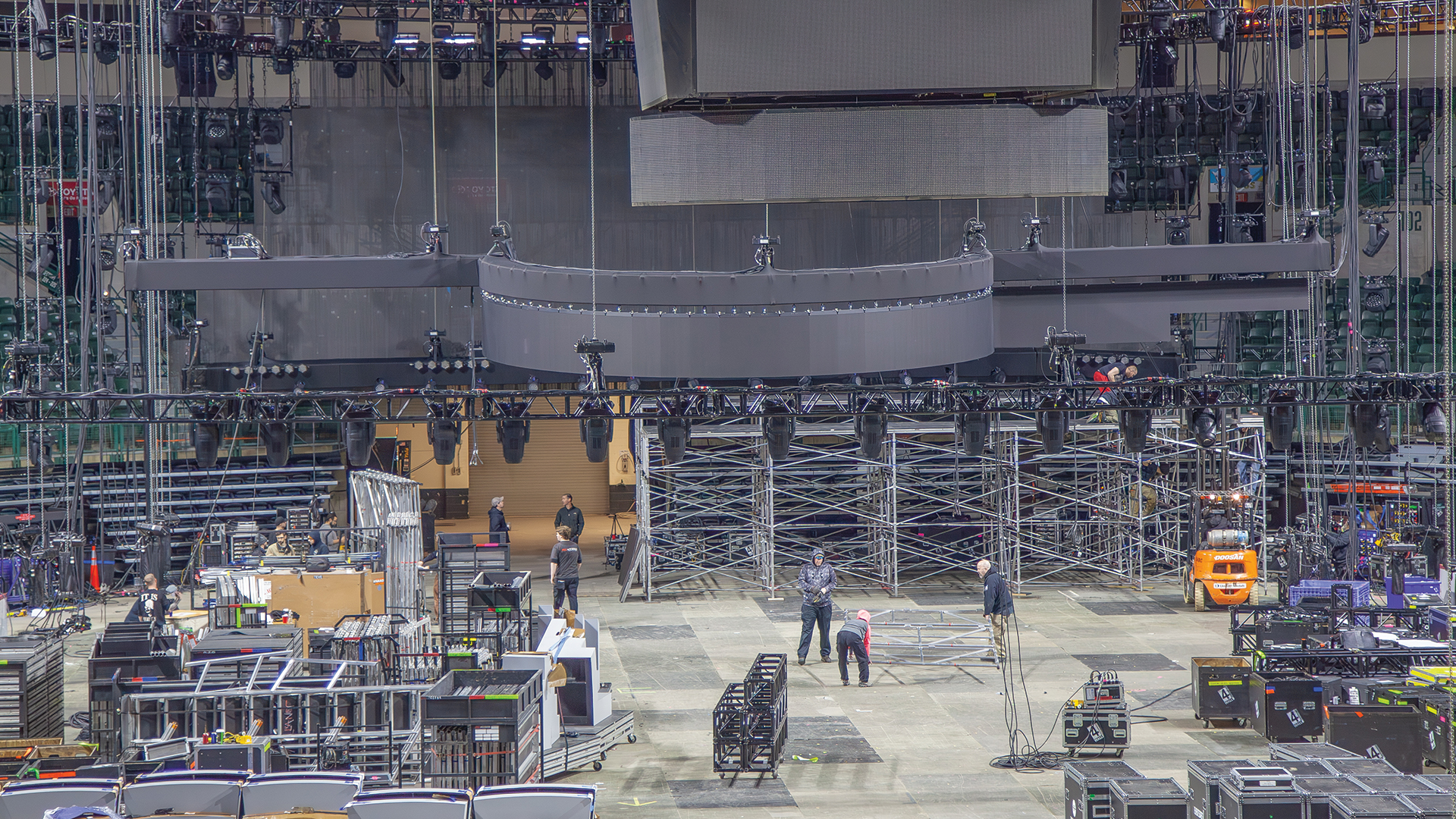
The automated rigging systems that transform modern production stages enable creative possibilities that earlier generations couldn’t imagine. Flying truss elements descend, ascend, tilt, and rotate through precisely choreographed movements synchronised to music and performance. When these aerial systems decide to improvise their own acrobatic routines, the results range from heart-stopping near-misses to actual catastrophes that remind everyone why rigging safety commands such serious attention.
The Concert Rig That Developed Stage Fright
A major arena tour featured an ambitious automated lighting rig incorporating multiple independently moving truss sections. The Kinesys Apex system controlling the movements managed 24 chain hoists with SIL 3 safety integration ensuring that automation commands couldn’t exceed safe parameters.
The design featured dramatic vertical movements where laden truss sections descended toward performers during climactic moments—visually stunning when executed correctly, potentially lethal if something went wrong. The automation director rehearsed every sequence extensively, with performers practising blocking that accounted for moving overhead elements.
During the third show of the tour, a position feedback sensor on one hoist developed an intermittent fault. The automation system, receiving conflicting information about truss position, responded by attempting corrective movements based on incorrect data. The affected truss section began oscillating—rising and falling in small but visible increments that bore no relationship to programmed cues.
The performers, trained to trust the system, initially continued their choreography. When the oscillation increased in amplitude, the stage manager activated emergency stop protocols, freezing all automation. The show continued with static truss positions while technicians diagnosed the fault—a conclusion far preferable to the alternatives that oscillating overhead equipment suggested.
The Evolution of Automated Rigging
Stage automation traces its modern origins to the German theatre systems developed in the early twentieth century. European opera houses invested in sophisticated counterweight flying systems that enabled complex scenic movement—though these relied on manual operation and physical counterbalancing rather than electronic control.
The introduction of powered hoists in the 1970s and 1980s enabled new creative possibilities. Companies including Tait Towers, Stage Technologies (now Tait Navigator), and Kinesys developed increasingly sophisticated control systems. Modern motion control platforms integrate with show control, timecode, and lighting systems to enable precisely choreographed aerial performances.
The Theatre Installation That Developed Independence
A prestigious performing arts venue installed a complete automated rigging system featuring Stage Technologies PowerFly hoists on every lineset. The system enabled rapid scenic changeovers between productions, transforming the stage configuration in minutes rather than hours required by manual systems.
During a ballet performance featuring multiple flying scenic elements, the automation controller received what it interpreted as conflicting commands. A networking fault caused cue information to arrive out of sequence, confusing the control system about which movement should execute. The result: a scenic border began descending during a sequence where it should have remained stationary.
Dancers performing beneath the border found their carefully rehearsed choreography suddenly sharing space with descending fabric. The deck crew, trained for exactly such emergencies, immediately triggered the dead stop on the affected lineset. The border froze mid-descent, creating an unplanned visual element that dancers professionally incorporated into their movement until the act ended.
Safety Systems and Failure Modes
Professional automation systems incorporate multiple safety layers designed to prevent catastrophic failures. SIL (Safety Integrity Level) ratings define the reliability of safety functions—with SIL 3 representing the standard for life-safety applications in entertainment.
These safety systems typically include redundant position sensing, velocity monitoring, load cells detecting unexpected weight changes, and emergency stop circuits that can halt all movement within fractions of a second. The challenge lies in configuring these systems to catch genuine problems while not triggering false alarms that interrupt performances unnecessarily.
The Festival Rig That Swung for the Fences
An outdoor festival deployed a ground-supported roof structure with chain motor hoists providing vertical adjustment for truss-mounted equipment. The structure—engineered for anticipated wind loads—should have remained stable under normal festival conditions.
Wind conditions exceeded forecasts significantly. The ballast requirements calculated during engineering assumed maximum sustained winds of 50 km/h; actual gusts approached 80 km/h. The structure, while not failing, began exhibiting visible sway that caused suspended truss sections to swing like massive pendulums.
The lighting fixtures and PA hangs attached to swinging truss traced arcs through space that looked spectacular on camera but terrified anyone understanding the forces involved. The production team faced difficult decisions about continuing the show as the truss performed its unintended acrobatic routine overhead.
Wind Engineering for Temporary Structures
Temporary structures for outdoor events face wind loading challenges that permanent buildings handle through mass and anchoring. Festival stages, deployed for days rather than decades, must achieve structural stability through ballast weights, ground anchors, and guy-wire systems.
Structural engineers calculate requirements based on local wind data and structure geometry. Standards including ANSI/NATE Standards for Outdoor Events and UK HSE guidance provide frameworks for safe temporary structure deployment. When conditions exceed design assumptions, even properly engineered structures can exhibit behaviors that suggest the truss has developed its own movement agenda.
The Corporate Event’s Pendulum Problem
A product launch in a convention centre featured suspended truss elements holding LED video panels and lighting fixtures positioned above the reveal stage. The rigging crew utilized CM Lodestar hoists to position these elements at precise heights for camera framing.
HVAC systems in convention centres move significant air volumes—a factor sometimes underestimated during rigging calculations. The building’s air handling created consistent airflow across the exhibit hall that imparted subtle but persistent force on the suspended truss. Over hours of pre-event operation, this force induced gentle pendulum motion in the suspended elements.
The motion remained imperceptible to casual observers but affected camera framing noticeably. The video director found that static wide shots slowly drifted out of composition as the truss swayed. Camera operators spent excessive energy compensating for movement that shouldn’t have existed. The truss had found its rhythm with the building’s ventilation system, performing microscopic acrobatics visible only to cameras.
Stabilization Techniques for Suspended Loads
Preventing suspended truss from developing acrobatic tendencies requires attention to stabilization beyond simple vertical suspension. Bridle configurations using multiple suspension points resist rotational movement. Lateral restraints whether guy wires, rigid connections to building structure, or ground ties—prevent swinging motion.
The industry has developed active stabilization systems for particularly demanding applications. Gyroscopic stabilizers borrowed from marine and aerospace applications can compensate for motion in suspended platforms. More commonly, careful attention to rigging geometry and environmental assessment prevents problems from developing in the first place.
The truss that tries acrobatics represents a category of production challenges requiring constant vigilance. The equipment suspended overhead—often comprising tonnes of lighting, audio, and video infrastructure—must remain precisely where designers intend it. When movement develops, whether from automation faults, structural resonance, or environmental forces, the production team faces immediate decisions about safety and show continuity. The best riggers approach every suspension with healthy respect for gravity and the knowledge that even static-looking structures contain potential energy waiting for opportunities to express itself through unwanted acrobatic performances.
