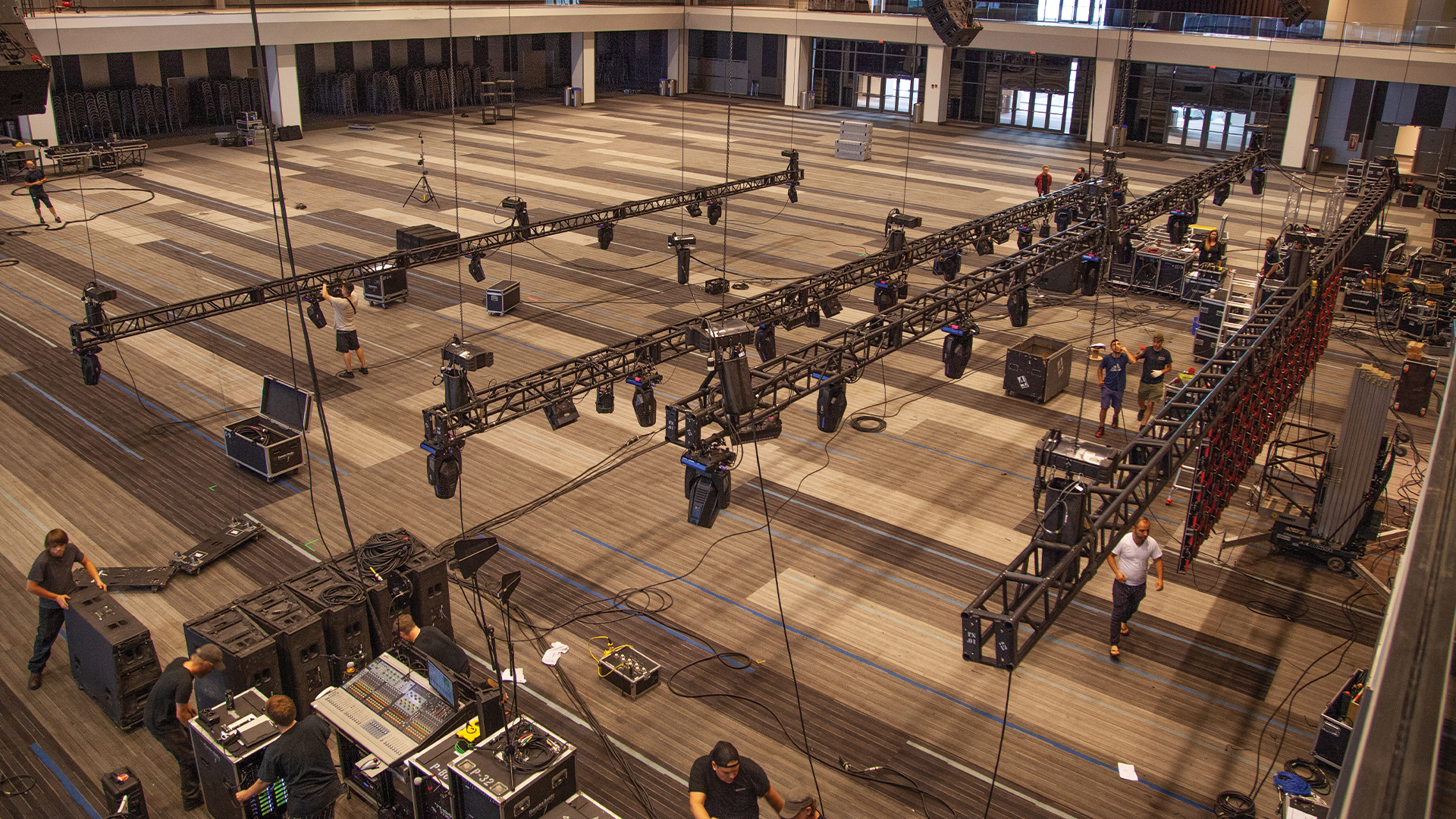
The fundamental promise of aluminum truss systems is structural stability—rigid frameworks that hold expensive equipment safely above audiences and performers. When that stability falters, when carefully engineered structures decide they’d prefer a different configuration, the results range from minor inconvenience to catastrophic failure. The rigging industry has accumulated decades of wisdom about truss behavior, much of it learned through experiences that nobody wishes to repeat.
The Engineering Behind Stability
Understanding truss migration requires understanding truss design. Modern entertainment truss evolved from aerospace structural engineering, adapted for the unique demands of touring production. The triangulated geometry that defines truss design—whether in 12-inch box truss or 20.5-inch heavy-duty sections—distributes loads along member axes, theoretically eliminating bending moments that could cause failure.
Manufacturers like Tyler Truss, Global Truss, and Prolyte engineer their products to specific working load limits (WLL) that include safety factors typically between 5:1 and 8:1. These calculations assume proper assembly, correct hardware installation, and loads applied within design parameters. When any of these assumptions prove incorrect, truss begins expressing its structural opinions in ways that alarm everyone nearby.
Connection Point Conspiracies
The most common source of truss movement involves connection points—the bolted or pinned joints where individual sections meet. The industry standard conical coupler system uses tapered connections that should self-align and lock firmly. “Should” carries significant weight in that sentence. Worn couplers, damaged receiving cups, or insufficiently torqued hardware create joints with perceptible play. Under dynamic loading—when motors raise and lower, when wind buffets outdoor structures, when heavy equipment shifts—that play accumulates into visible movement.
The TOMCAT brand truss popularized the fork and spigot connection system that remains common in North American production. These connections require full insertion of the spigot into the receiving tube, secured by R-clips or bolts through aligned holes. Field conditions rarely match factory specifications. Stagehands working under time pressure might not verify complete insertion. Dirt and debris accumulation in receiving tubes prevents full engagement. The truss section that seemed secure during assembly begins working loose as vibration and load cycling exploit the inadequate connection.
Thermal Expansion Adventures
Aluminum thermal expansion creates truss movement that surprises engineers unfamiliar with outdoor installation. Aluminum expands approximately 0.0000129 inches per inch per degree Fahrenheit. A 60-foot truss run experiencing a 50-degree temperature swing from morning setup to afternoon show will change length by nearly half an inch. That dimensional change must go somewhere.
Constrained truss structures—rigidly connected at both ends—develop significant internal stress as temperatures change. The Applied Electronics ground support towers used at outdoor festivals sometimes exhibit visible bowing as afternoon sun heats the metal. Engineers who designed the structure assuming morning temperatures discover that thermal growth has pushed the system beyond its intended geometry. The truss hasn’t failed; it’s simply responding to physics in ways the design didn’t accommodate.
Wind Load Warfare
Outdoor truss installations face wind loading that transforms stable structures into dynamic systems. The Stageline mobile stages deployed across festival circuits include engineering for specific wind speeds, typically rated for sustained winds of 25-35 mph depending on configuration. When actual wind exceeds design assumptions, or when gust factors create momentary loads far exceeding sustained values, truss structures respond with movement their operators never expected.
The Serious Stages and Mountain Productions engineering teams calculate wind loads using ASCE 7 standards, considering factors like exposure category, topographic effects, and structure height. These calculations produce designs that should remain stable under specified conditions. “Specified conditions” becomes the critical phrase—a thunderstorm cell producing 60 mph gusts will overwhelm structures engineered for 35 mph sustained winds regardless of how carefully the engineering was performed.
Rigging Point Reliability
Truss doesn’t move in isolation—it moves relative to its rigging points. The anchor points that connect truss to venue structure or ground support must resist all loads the truss experiences. When those anchors slip, stretch, or shift, the truss moves accordingly. Arena venues with purpose-built rigging steel typically provide reliable anchor points, though even these can surprise riggers when venue modifications have altered load paths without updating documentation.
The CM Lodestar motors that have become industry standard for truss lifting introduce their own movement potential. Motor brakes must hold loads against gravity while maintaining precise position. Brake wear, incorrect adjustment, or thermal expansion of brake components can allow subtle slip that accumulates over time. A truss that was level at load-in might show perceptible tilt after hours of operation as brake slip allows gradual position change.
The shift toward automated rigging using systems like Creative Conners automation and Tait Navigator has introduced new categories of truss movement. These systems intentionally move truss during performances, relying on sophisticated motion control and safety systems. When those systems encounter unexpected conditions—obstructions, encoder failures, communication errors—the truss might end up in positions nobody intended, stubbornly refusing to return to programmed locations until the underlying issue is resolved.
Load Distribution Dynamics
How loads attach to truss affects structural behavior more than many operators realize. The cheeseborough clamps and C-clamps that attach lighting fixtures to truss create point loads that can cause localized deflection. When those point loads cluster in one area—perhaps because the lighting designer wanted a particular visual grouping—the truss deflects more at that point than elsewhere. The resulting curve might be subtle, but it represents the truss moving from its intended geometry.
Moving head fixtures create dynamic loads that static calculations don’t capture. A Robe BMFL Blade swinging from one position to another generates acceleration forces that momentarily increase the load it applies to the truss. When dozens of fixtures move simultaneously during complex cues, the cumulative dynamic loading can exceed static assumptions. Truss designed with appropriate static safety factors might experience movement as dynamic loads approach design limits.
Historical Lessons in Truss Behavior
The entertainment industry’s understanding of truss stability has been shaped by tragic failures. The Indiana State Fair stage collapse in 2011 killed seven people when straight-line winds exceeding 60 mph toppled a temporary stage structure. Subsequent investigation revealed the structure was designed for significantly lower wind loads than it experienced. The industry response included updated ANSI/ESTA standards for temporary structures and increased attention to weather monitoring protocols.
The Entertainment Services and Technology Association (ESTA) has developed comprehensive standards for truss design, manufacturing, and inspection. The ANSI E1.2 standard for entertainment industry aluminum trusses establishes requirements that reputable manufacturers follow. Understanding these standards helps operators recognize when truss systems are operating outside their design envelope—before that operation results in visible movement or worse.
Practical Prevention Protocols
Preventing truss migration begins with rigorous pre-production planning. Verify that truss quantities, configurations, and load capacities match what the design requires. Confirm that connection hardware is compatible across different truss manufacturers—mixing Thomas truss with James Thomas Engineering products might work in some configurations but create problematic joints in others. Document expected loads at each point and verify they fall within published ratings.
Implement systematic connection verification during assembly. Every pin, bolt, and coupler should be visually confirmed and physically tested before loads are applied. The buddy system approach—where one person assembles and another verifies—catches errors that individual operators might miss. This investment of time during setup prevents the much larger investment of time, money, and potentially lives when connections fail during operation.
Establish ongoing monitoring protocols for outdoor installations. The Davis Instruments Vantage Vue weather stations commonly deployed at festivals provide real-time wind speed data. Pre-establish wind hold protocols that define specific actions at specific wind speeds—pausing motor movement at 20 mph, lowering scenic elements at 25 mph, evacuating structures at 30 mph. These protocols should be documented, communicated, and rehearsed before conditions require their implementation.
Building Respect for Structural Limits
The truss that refuses to stay in place is usually communicating something important about the conditions it’s experiencing. That communication might indicate connection failures, thermal stress, wind loading, or load distribution problems. Operators who recognize these signals and respond appropriately avoid the catastrophic failures that result when warnings go unheeded.
The rigging industry has developed a safety culture that prioritizes structural integrity above schedule pressure or client demands. A head rigger who refuses to fly a load that exceeds their comfort level is exercising professional judgment that should be respected. The show matters, but not more than the safety of everyone beneath that truss.
Truss movement, ultimately, reflects the intersection of engineering design with real-world conditions. The goal isn’t to prevent all movement—some flexibility is designed into structures specifically to accommodate thermal and dynamic effects. The goal is ensuring that movement remains within designed parameters, that connections maintain integrity, and that everyone working near overhead rigging understands both the capabilities and limitations of the structures above them.
